
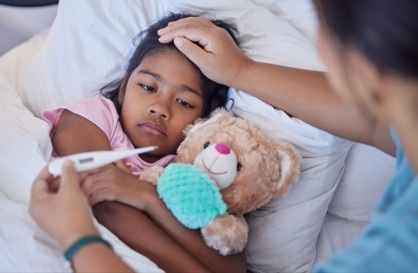
Maybe the thermometer reads 102°F at bedtime and your child is flushed and fussy. Maybe a new rash has spread across their chest by morning. Or maybe there’s no fever and no rash at all, just a cold that has dragged on all week and now seems to be turning into something else.
Every parent knows this moment, and it comes with the same questions. Is this serious, or can it wait? Do we call now, or watch through the night?
Here’s what makes it tricky: the number on the thermometer rarely tells the whole story. When it comes to a child’s fever, when to worry depends on their age, how they look and act, how long symptoms last, and what else is going on, like a rash or a stuffy nose.
In this guide, we’ll give you a simple worry-vs-wait framework for fever, rash, and cold symptoms, so you can tell what’s fine to handle at home, what deserves a call to our office today, and what needs care right away.
Quick Q&A
When should you worry about a child’s fever?
It depends on age and behavior. Any fever of 100.4°F or higher in a baby under 3 months needs a call right away, while older children are usually watched unless the fever lasts more than 24 hours (under 2) or 3 days (age 2 and older), or their behavior worries you. We break it down by age below.
What temperature is a fever in a child?
Most pediatricians consider a temperature above 100.4°F (38°C) a fever. How your child looks and acts often tells you more than the number, so we cover the warning signs that matter most further down.
When should you call the doctor about a rash with a fever?
A rash with a fever in a child is a reason to call us the same day, and purple or blood-colored spots that don’t fade when pressed need emergency care. Our rash guide below sorts what can wait from what can’t.
Is a fever with a runny nose usually just a cold?
Often, yes. A low fever is common with a cold, and most colds fade over about 7 to 10 days. Call us if your child has trouble breathing, ear pain, or isn’t getting better each day.
What can you do at home for a child with a fever?
Start with comfort: fluids, light clothing, and rest, and call us before giving any medicine to a child under 2. If you’d rather have your child seen, we offer same-day sick appointments. Book online or call our office.
When Should You Worry, and When Can You Wait? A Quick Guide
Most fevers, rashes, and colds can be watched at home for a day or two, but a few signs mean it’s time to call or come in. With child fever, when to worry depends mostly on your child’s age, how long the fever lasts, and how they’re acting.¹ Use this chart to sort what you’re seeing.
| Symptom | Wait and watch | Call us today | Emergency care |
|---|---|---|---|
| Fever | Fever in a child 3 months or older who acts more like themselves once the fever comes down, and it has lasted less than 24 hours (under age 2) or less than 3 days (age 2 and older)¹ | A fever that lasts longer, or rises above 104°F repeatedly. A child who still acts sick after the fever comes down, or a fever with a stiff neck, severe headache, severe sore throat, severe ear pain, or repeated vomiting or diarrhea¹ | Any fever in a baby younger than 3 months.¹ ⁶ Also trouble breathing, a seizure, or a child who is not alert when awake⁶ |
| Rash | Hives that come and go within hours,³ or a small, mild rash without fever in a child who feels fine | Any widespread rash (contact us within 24 hours), a rash with fever, large blisters, bright red skin that peels in sheets, bloody crusts on the lips, or a child who looks or acts very sick² | Purple or blood-colored spots or dots, or a child too weak to stand.² Hives with swelling of the face, lips, tongue, or throat, trouble breathing or swallowing, vomiting, or dizziness³ |
| Cold | Runny nose, sneezing, cough, and low fever that improve a little each day. Most colds fade over 7 to 10 days⁴ ⁵ | Not better after a week, a daytime cough lasting more than 10 days, nasal mucus lasting more than 10 to 14 days, or a child who is too sleepy or cranky⁴ | Trouble breathing, ribs pulling in with each breath, or bluish lips or face⁶ |
The short version: how your child looks and acts matters as much as the thermometer reading or the spots on their skin.¹
For a fuller list of cold and flu warning signs, see our guide to knowing when it is a cold, the flu, or something else.
What Counts as a Fever in Children?
Most pediatricians consider a temperature above 100.4°F (38°C) a fever.⁷ So if you’re asking what temperature is a fever in a child, that’s the number to remember. A fever is usually a sign that the body is fighting an illness or infection,⁷ which makes it a useful clue to pay attention to.
The reading itself is only part of the story. Some children feel fine with a fever,⁷ and the main reason to treat one is to help a child feel better when they’re uncomfortable or in pain.⁷ How your child looks and acts often tells you more. Contact your pediatrician if a child with a fever looks very ill, seems unusually drowsy or very fussy, or still acts sick after the fever comes down.¹
The right response also depends on your child’s age.
Child Fever: When to Worry by Age
Age changes the answer more than almost anything else. Here’s how to think about it at each stage.
Babies Under 3 Months
When it comes to baby fever, the answer to “when to call the doctor” is simple: right away. Contact us if a baby younger than 3 months (12 weeks) has a temperature of 100.4°F or higher.¹ Please also call before giving any medicine to a child under 2.⁸
Babies and Toddlers, 3 Months to 3 Years
For toddler fever, when to worry depends on how long it lasts. In a child under 2, call if the fever lasts more than 24 hours. From age 2 on, the mark is 3 days.¹ Toddlers can’t tell you what hurts, so their behavior is the best clue. Call if your child looks very ill, is unusually drowsy, is very fussy, or if they still seem sick after the fever comes down, or if they seem to be getting worse.¹
Older Children
Older kids can tell you how they feel, which helps. Call if the fever lasts more than 3 days, rises above 104°F more than once, or is accompanied by a stiff neck, severe headache, severe sore throat, severe ear pain, trouble breathing, an unexplained rash, or repeated vomiting or diarrhea.¹
What Changes the Picture
Some children need a call sooner, whatever their age. That includes children with immune system problems such as sickle cell disease or cancer, children with heart problems, and children who have had a seizure. It also includes any child who has been in a very hot place, like an overheated car.¹
Once the fever has passed, our post, Is My Child Too Sick for School? explains when it’s safe to head back. Our guidance is to wait at least 24 hours after the fever subsides without medication.
How Do You Take a Child’s Temperature Accurately?
When it comes to taking a child’s temperature, use a digital thermometer and skip the old mercury kind.⁹ The best method depends on your child’s age:
- Under 3 months: A rectal temperature provides the most accurate reading.⁹
- 6 months and older: An ear thermometer works, but it isn’t reliable for younger babies, whose ear canals are too narrow.⁹
- Any age: A forehead (temporal artery) thermometer can be used, and an armpit reading is the least accurate, but can be used to screen at any age.⁹
- 4 years and older: You can take a temperature by mouth.⁹
Timing affects accuracy, too. Wait 30 minutes after a hot or cold drink before taking an oral temperature, and wait 15 minutes after coming in from a cold day before using an ear thermometer.⁹ Direct sunlight or cold air can also throw off a forehead reading.⁹
Fever Red Flags That Matter More Than the Number
Some of the most important warning signs of a child’s fever have little to do with the thermometer. If a fever is accompanied by any of the following, call us. Trouble breathing and a child who is not alert are emergencies, so seek care right away.
- Trouble breathing, fast breathing, or ribs pulling in with each breath¹ ⁶
- A stiff neck or a severe headache¹
- Unusual drowsiness, or a child who is not alert or interacting when awake¹ ⁶
- Signs of dehydration: no urine for 8 hours, a dry mouth, or no tears when crying⁶
- A fever above 104°F that keeps coming back or that medicine can’t bring down¹ ⁶
A note on febrile seizures. Sometimes a fever triggers a seizure in an otherwise healthy child, most often between 6 months and 5 years old. Most febrile seizures are short, usually lasting less than a minute or two, and do not cause lasting harm.¹⁰ Call your child’s doctor after any seizure, and call 911 if it doesn’t stop after 5 minutes.¹⁰
Rash With or Without a Fever: When to Worry
Most rashes are harmless, but a few need prompt attention. When to see a doctor for a child’s rash depends on how it looks, how quickly it spreads, and whether your child has a fever or seems unwell.
Rashes That Can Usually Wait
Heat rash appears as patches of tiny red bumps or small fluid-filled blisters, most often on the upper chest, back, and neck folds. Cooling your child in a cool bath or with cool, moist compresses, drying the skin completely, and dressing them in thin, loose cotton usually does the trick, and the rash should clear within about 3 days.¹¹
A mild viral rash usually looks like small pink spots that fade when pressed. Most rashes are part of a viral illness, and a child who otherwise feels well can usually be watched. If the rash becomes widespread, give us a call within 24 hours.²
Hives vs. heat rash: Hives are raised welts that come and go within hours,³ while heat rash appears as tiny red bumps or small blisters. Our guide to telling heat rash apart from hives and other allergic reactions walks through the differences.
Rashes That Need a Call Today
If a child has a rash with a fever, call us.¹ Call too if a rash gets worse over 24 hours,¹¹ or if it’s widespread, even without other symptoms.² The same goes for large blisters, bright red skin that peels in sheets, bloody crusts on the lips, or a child who looks or acts very sick.² With heat rash, also call if your child is eating less or is less active, if the rash looks infected, or if it isn’t gone after 3 days of home care.¹¹
Rashes That Need Emergency Care
Get help right away for:
- Purple or blood-colored spots or tiny dots that don’t fade when pressed. Call 911 if there’s a fever, and go to the ER if there isn’t .²
- Hives with swelling of the face, lips, tongue, or throat, trouble breathing or swallowing, vomiting, or dizziness.³
- A rash along with a child who is not alert when awake or is too weak to stand.²
Toddler Fever and a Runny Nose: Is It Just a Cold?
If your toddler has a fever and a runny nose, take a breath: it’s very often a cold. A typical cold can bring a low fever of 101 to 102°F, particularly at night, along with a runny nose, sneezing, and a cough.⁴ When parents weigh cold vs. fever, it helps to know the two often arrive together. Kids with a cold also recover on a familiar timeline, with symptoms peaking in the first few days and fading over about 7 to 10 days.⁴ ⁵
So what shifts the picture from “watch it” to “call us”? Reach out if your child:
- Has a temperature above 102°F⁴
- Has ear pain, or ongoing fussiness or crying⁴
- Is too sleepy or cranky, or isn’t getting better each day⁴
- Has nostrils that widen with each breath, or lips or nails that turn blue⁴
- Still has a daytime cough after 10 days, or nasal mucus after 10 to 14 days⁴
For babies 3 months or younger, call us at the first sign of illness.⁴
Meanwhile, our tips for stopping a runny nose in children can help your toddler feel better, and our guide explains how colds and the flu differ.
What Can You Do at Home While You Wait?
If you’re wondering how to treat a fever in kids at home, start with comfort. Offer plenty of fluids and let your child rest.¹² Dress them in one layer of lightweight clothing with a lightweight blanket for sleep, and don’t bundle up a child who has chills.¹² A lukewarm bath or sponge bath can help, but skip cold baths, ice, and alcohol rubs.¹²
Fever reducers are mainly there to help your child feel better.⁷ Acetaminophen and ibuprofen both help, and doses go by weight when you know it, and by age when you don’t.⁸ ¹² Ibuprofen is only for children 6 months and older; aspirin should be avoided because of its link to Reye syndrome, and please call us before giving any medicine to a child under 2.⁸
Keep a simple log of each temperature, the time you took it, any medications and their doses, and any new symptoms. It makes your call with our team faster and more useful.
Partnering With Wake Forest Pediatrics
Deciding whether to worry or wait is hard to do alone, whether it’s 2 a.m. or the middle of a busy workday, and you don’t have to. Since 1998, our board-certified pediatricians and nurse practitioners have helped families in Wake Forest and Knightdale work through fevers, rashes, and every kind of cold, from the first warm forehead to the last lingering cough.
If your child is sick, we offer same-day sick appointments, and our on-site lab can test for flu and strep. Whether you’re looking for a pediatrician in Wake Forest or a pediatric practice in Knightdale that makes time for your questions, we’re here for your family.
When in doubt, reach out. Call our office or book online, and get to know the providers who care for local kids on our care team page. A quick call can save a night of worry.
Sources
- American Academy of Pediatrics (HealthyChildren.org). “Fever: When to Call the Pediatrician.” https://www.healthychildren.org/English/health-issues/conditions/fever/Pages/When-to-Call-the-Pediatrician.aspx
- Centers for Disease Control and Prevention (CDC). “Signs and Symptoms of Flu.” https://www.cdc.gov/flu/signs-symptoms/index.html
- American Academy of Pediatrics (HealthyChildren.org). “Hives (Urticaria) in Children: Causes, Symptoms & Treatment.” https://www.healthychildren.org/English/health-issues/conditions/skin/Pages/Hives.aspx
- American Academy of Pediatrics (HealthyChildren.org). Symptom Checker, “Rash or Redness, Widespread.” https://www.healthychildren.org/English/tips-tools/symptom-checker/Pages/symptomviewer.aspx?symptom=Rash+or+Redness+-+Widespread
- American Academy of Pediatrics (HealthyChildren.org). “Children & Colds (Upper Respiratory Infections).” https://www.healthychildren.org/English/health-issues/conditions/ear-nose-throat/Pages/Children-and-Colds.aspx
- CDC. “About Common Cold.” https://www.cdc.gov/common-cold/about/index.html
- American Academy of Pediatrics (HealthyChildren.org). “Signs and Symptoms of Fever.” https://www.healthychildren.org/English/health-issues/conditions/fever/Pages/Signs-and-Symptoms-of-Fever.aspx
- American Academy of Pediatrics (HealthyChildren.org). “How to Care for Your Child’s Cold.” https://www.healthychildren.org/English/health-issues/conditions/flu/Pages/caring-for-Your-childs-cold-or-flu.aspx
- American Academy of Pediatrics (HealthyChildren.org). “How to Take Your Child’s Temperature.” https://www.healthychildren.org/English/health-issues/conditions/fever/Pages/How-to-Take-a-Childs-Temperature.aspx
- American Academy of Pediatrics (HealthyChildren.org). “Febrile Seizures in Children.” https://www.healthychildren.org/English/health-issues/conditions/fever/Pages/Febrile-Seizures.aspx
- American Academy of Pediatrics (HealthyChildren.org). “Heat Rash (Prickly Heat) in Babies & Young Children.” https://www.healthychildren.org/English/ages-stages/baby/bathing-skin-care/Pages/Heat-Rash.aspx
- MedlinePlus (National Library of Medicine). “Fever.” https://medlineplus.gov/ency/article/003090.htm

