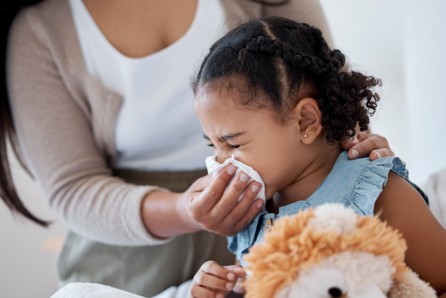
It’s 2 a.m., and you’re standing beside your child’s bed with a hand on a forehead that feels a little too warm. Their nose is stuffy, they’re cranky and restless, and one question keeps circling in your mind: is this a cold or the flu?
You’re in good company. Cold vs. flu symptoms in kids overlap more than any parent would like, and a few other childhood illnesses can look just like them. Telling them apart matters, because the answer shapes how closely you watch your child, what helps at home, and when it’s time to pick up the phone.
In this guide, you’ll learn a quick way to tell whether it’s a cold or the flu, meet the other common illnesses that can mimic both, and see the clear signs that mean it’s time to call us.
Quick Answers
How can you tell a cold from the flu in kids?
Speed and severity are the biggest clues. Flu tends to hit suddenly and feel much worse, while a cold builds gradually and stays milder. See the side-by-side symptom table in How Can You Tell a Cold From the Flu in Kids?
What else can look like a cold or the flu?
Strep throat, RSV, ear infections, croup, allergies, and COVID-19 can all overlap with cold and flu symptoms, and each has a telltale sign. We cover them in What Else Can Look Like a Cold or the Flu?
How long does a cold last in kids?
Most colds fade over about 7 to 10 days, and the flu usually runs a little longer. The pattern to watch for is a child who improves and then gets worse again. Find out more in How Long Do Cold and Flu Symptoms Last in Kids?
When should you take a child with a cold or flu to the doctor?
Call us the same day for a fever lasting days, severe ear or throat pain, or unusual drowsiness. Trouble breathing, dehydration, or any fever in a baby under 3 months needs emergency care right away. Use our checklist in When Should You Call the Doctor or Seek Care Right Away?
Can a pediatrician test for flu and strep on the spot?
Yes. Our on-site lab offers flu and rapid strep tests, and we offer same-day sick appointments. Book online or call our office.
How Can You Tell a Cold From the Flu in Kids?
The quickest clues are how quickly symptoms appear and how sick your child seems. Flu symptoms typically come on suddenly and feel more intense, while cold symptoms tend to build gradually and stay milder.¹ ² Here’s how the two compare at a glance.
| Symptom | Cold | Flu |
|---|---|---|
| Onset | Gradual | Sudden |
| Fever | None or low-grade | Often sudden, usually above 100.4°F (though not every child gets one) |
| Body aches and headache | Mild or absent | Common, and can be intense |
| Fatigue | Mild | Often much more tired than usual |
| Cough | A small amount | Can be persistent |
| Runny or stuffy nose | Very common | Sometimes |
| Vomiting or diarrhea | Uncommon | More common in children than in adults |
The short version: flu hits fast and hard, and a cold builds slowly.
Real life doesn’t always follow the chart. Not every child with the flu runs a fever ,² and young kids can’t always tell you what hurts. A toddler with body aches may simply turn clingy, refuse to play, or want to be held more than usual. Child flu symptoms can also include vomiting and loose stools, which surprises many parents.³
When your child seems much sicker, achier, and more miserable than a typical cold would explain,³ treat that as a clue in itself. It’s worth noting what changed, and how quickly, so you can share it if you call our office.
What Does a Cold Look Like in Children?
Child cold symptoms usually start small and build over a day or two. A clear, watery, runny nose and sneezing often come first, followed by a mild cough, a sore throat, and on-and-off fussiness.⁴ Some kids run a low fever, and a few have a mild headache or slight body aches.⁵
A toddler’s runny nose tends to change as the cold runs its course. Mucus typically starts out clear and thin, then turns thicker and often takes on a yellow or green tint.⁴ Symptoms usually peak within two to three days,⁵ then fade slowly. Most colds clear up in about 7 to 10 days.⁴ ⁵
If it feels like your child is sick all the time, you’re not imagining it. Children often catch more colds than adults, and most have about 8 to 10 colds in their first two years alone.⁴ ⁵ Time in childcare, or an older sibling bringing germs home from school, pushes that number even higher.⁴
While a cold runs its course, comfort is the goal. Our guide to home remedies for a runny nose in children covers what helps.
What Does the Flu Look Like in Children?
Child flu symptoms tend to arrive all at once. A child who was playing at lunch can be flushed and miserable by dinner, with a sudden fever (usually above 100.4°F), chills, a headache, body aches, and a dry, hacking cough.³ A sore throat and a stuffy or runny nose can tag along. Exhaustion is often the giveaway, because kids with the flu are usually much more tired than usual.³
Flu can also hit the stomach. Vomiting and diarrhea are more common in children than in adults,² so a tummy bug accompanied by a fever and aches may be the flu. With flu in toddlers, who can’t tell you what hurts, a sudden change in behavior is often the first clue.
Some children face a higher risk of serious complications. That includes children younger than 5, especially those under 2, and children with chronic conditions such as asthma or diabetes.⁶ Complications can include pneumonia, ear and sinus infections, dehydration, and a flare-up of asthma.⁶
Most healthy children recover from the flu in about a week.³ Even so, the flu is generally worse than a common cold ,¹ which is why it deserves closer watching, especially for the children described above. If your child belongs to one of those groups and develops flu symptoms, call our office early.
Our guide to the importance of flu vaccines for your child explains how the yearly vaccine helps protect them.
What Else Can Look Like a Cold or the Flu?
Colds and the flu get most of the blame, but several other illnesses can look similar at first. Here’s what sets each one apart.
Strep Throat
A sore throat that starts very quickly, along with fever, pain when swallowing, and red, swollen tonsils, points toward strep. When sorting out strep throat vs. a cold, a cough, runny nose, or hoarse voice usually suggests a virus instead.⁷ Only a test can confirm strep.
RSV
RSV often starts like a cold, with a runny nose, congestion, cough, and reduced appetite, which makes it hard to distinguish RSV from a cold in toddlers at home. Watch for wheezing and breathing difficulty. In very young infants, the only signs may be irritability, low activity, and trouble breathing.⁸ Our post on colds, flu, or RSV and how to know what’s going around can help you sort out which illness is circulating.
Ear Infection
Pain is the most common symptom. Younger children may seem irritable and cry, and they may have trouble sleeping, reduced appetite, or a fever.⁹ A cold can also change pressure in the middle ear and cause ear pain, and a provider has to examine the eardrum to diagnose an infection.⁹
Croup
Croup often starts out like a cold, then slowly turns into a barky cough. Your child’s voice may become hoarse, and some children make a coarse, musical sound when breathing in, called stridors. Most children with viral croup have a low fever.¹⁰
Allergies
Red, itchy, watery eyes are a hallmark of allergies and are not typical of a cold. Allergy mucus tends to be thin and clear, fever is unusual, and symptoms usually last three weeks or more, compared with 3 to 14 days for a cold.¹¹ For more on telling the two apart, see our guide to how to tell if your child has allergies or just a cold.
COVID-19
COVID-19 has symptoms similar to the flu and RSV, and a child can have two of these illnesses at the same time. Because of the overlap, the AAP recommends testing children who have symptoms without delay.¹²
For a fuller rundown of the illnesses parents see most, read our guide to 10 common childhood illnesses.
How Long Do Cold and Flu Symptoms Last in Kids?
So, how long does a cold last in kids? A typical cold fades slowly over 7 to 10 days, with symptoms peaking in the first two to three days and easing after that.⁴ ⁵ The flu usually runs a little longer. Most people recover in a few days to less than two weeks ,² and healthy children often get over it in about a week.³
Normal recovery looks like steady progress. Your child should feel a little better each day, even if a stuffy nose or a cough lingers for a while.⁴ Give us a call if a daytime cough lasts more than 10 days, or if nasal mucus lingers past 10 to 14 days.⁴
Also watch for the “better, then worse again” pattern. With the flu, a fever or cough that improves and then returns or worsens is a warning sign that needs prompt medical attention.²
What Helps at Home, and What Should You Skip?
Home remedies for a child’s cold or flu share one goal: keeping your child comfortable while their body does the work.
What helps
Offer plenty of fluids, especially if vomiting or diarrhea is involved, and let your child rest.¹³ A humidifier can ease a stuffy nose and a dry cough, and saline drops, sprays, or rinses help clear nasal passages.¹³ For children over 1, honey soothes the throat and coats cough receptors.¹³ For a runny nose in particular, see our guide to stopping a runny nose in children.
If a fever keeps your child from sleeping, acetaminophen or ibuprofen can help.¹³ Dose by weight when you know it, and by age when you don’t.¹⁴ Ibuprofen is only for children 6 months and older, and not for a child who is vomiting a lot or having trouble drinking.¹⁴ Call us before giving any medicine to a child under 2, and call right away if a baby under 3 months has a fever.¹⁴ We’re always glad to confirm dosing.
What to skip
Over-the-counter cough and cold medicines should not be given to children under 4 due to the risk of serious side effects.¹⁴ Never give aspirin, which has been linked to Reye syndrome, a rare but very serious illness that affects the liver and the brain.¹⁴
If you suspect the flu
What to give a child with the flu can include a prescription antiviral, which works best when started within two days of the first symptoms.¹⁵ That’s a good reason to call early.
When Should You Call the Doctor or Seek Care Right Away?
Most colds can be handled at home, and so can many cases of flu. Knowing when to take a child to the doctor takes the guesswork out of a stressful night. When it comes to a child’s fever, when to worry depends on your child’s age, how high it climbs, and how long it lasts.
Call us the same day if your child has:
- A fever lasting more than 24 hours in a child under 2, or more than 3 days in a child 2 or older¹⁶
- Severe ear pain, a severe sore throat, or a severe headache¹⁶
- Unusual drowsiness or fussiness¹⁶
Seek emergency care right away if your child has:
- Fast or trouble breathing, ribs pulling in with each breath, or bluish lips or face²
- Signs of dehydration: no urine for 8 hours, a dry mouth, or no tears when crying²
- Seizures, severe muscle pain (refusing to walk), or trouble staying alert and interacting when awake²
- A fever above 104°F that fever reducers can’t control²
- Any fever in a baby younger than 3 months (12 weeks)² ¹⁶
- A fever or cough that improves, then returns or worsens²
A note for kids with asthma: Colds and flu can trigger asthma symptoms, and a chronic condition that gets worse is a warning sign in its own right.² If your child’s breathing gets harder despite their usual medicines, call us right away. Our post on why colds sometimes trigger asthma symptoms and our asthma care page explain more.
Not sure which group your child falls into? Call our office, and we’ll help you decide. We offer same-day sick appointments, and you can book online or call us.
Can a Pediatrician Test for Flu and Strep on the Spot?
Yes. Our on-site lab includes flu and rapid strep tests, so most families don’t need an outside referral.
Timing is a big reason this matters. Strep throat is treated with antibiotics, yet only about 3 in 10 children with a sore throat actually have strep, so testing takes the guesswork out.⁷ For the flu, antiviral medicine works best when started within two days of the first symptoms, which makes early testing valuable.¹⁵
If you’re looking for a flu test for kids or a strep test near you in Wake Forest or Knightdale, we’re here to help. Book a same-day sick appointment or see the full list of tests on our services page.
How Can You Protect Your Child and Your Household?
If you’re wondering how to prevent the flu in kids, the CDC recommends a yearly flu vaccine as the best way to reduce the risk of the flu and its potentially serious complications.¹⁷ A flu shot for children is recommended for everyone 6 months and older, ideally by the end of October.¹⁷ Our guide to why the flu vaccine matters for your child explains who should get one and when, and our immunizations page covers the vaccines we offer.
Everyday habits add another layer of protection for the whole household:
- Wash your hands often with soap and water.
- Teach kids to cover coughs and sneezes with a tissue.
- Clean frequently touched surfaces.
- Avoid close contact with people who are sick.
- Keep a sick child home until symptoms are improving and they’ve gone at least 24 hours without a fever, without using fever-reducing medicine.¹⁷
Partnering With Wake Forest Pediatrics
Figuring out whether it’s a cold, the flu, or something else doesn’t have to be a guessing game, and you don’t have to do it alone. Since 1998, our board-certified pediatricians and nurse practitioners have helped local families sort through everything from the first sniffle to the middle-of-the-night worry.
If your child is coming down with something, we offer same-day sick appointments and on-site testing for flu and strep. Whether you’re looking for a pediatrician in Wake Forest or a Knightdale pediatrics team you can count on, we’re glad to see your family at either of our two locations.
Call our office or book online to schedule your child’s visit, and get to know the providers who will care for your family on our care team page. Peace of mind is part of every visit.
Sources
- Centers for Disease Control and Prevention (CDC). “Cold Versus Flu.” https://www.cdc.gov/flu/about/coldflu.html
- CDC. “Signs and Symptoms of Flu.” https://www.cdc.gov/flu/signs-symptoms/index.html
- American Academy of Pediatrics (HealthyChildren.org). “The Flu: What Parents Need to Know.” https://www.healthychildren.org/English/health-issues/conditions/flu/Pages/the-flu-what-parents-need-to-know.aspx
- American Academy of Pediatrics (HealthyChildren.org). “Children & Colds (Upper Respiratory Infections).” https://www.healthychildren.org/English/health-issues/conditions/ear-nose-throat/Pages/Children-and-Colds.aspx
- CDC. “About Common Cold.” https://www.cdc.gov/common-cold/about/index.html
- CDC. “Flu and Children.” https://www.cdc.gov/flu/highrisk/children.html
- CDC. “About Strep Throat.” https://www.cdc.gov/group-a-strep/about/strep-throat.html
- CDC. “Symptoms and Care of RSV.” https://www.cdc.gov/rsv/symptoms/index.html
- American Academy of Pediatrics (HealthyChildren.org). “Ear Infection Symptoms.” https://www.healthychildren.org/English/health-issues/conditions/ear-nose-throat/Pages/Ear-Infection-Symptoms.aspx
- American Academy of Pediatrics (HealthyChildren.org). “Croup in Young Children.” https://www.healthychildren.org/English/health-issues/conditions/chest-lungs/Pages/Croup-Treatment.aspx
- American Academy of Pediatrics (HealthyChildren.org). “Is It a Cold or Allergies? How to Tell the Difference.” https://www.healthychildren.org/English/health-issues/conditions/allergies-asthma/Pages/Is-It-Allergies-or-a-Cold-How-to-Tell-the-Difference.aspx
- American Academy of Pediatrics (HealthyChildren.org). “COVID-19 Testing and Kids: What You Should Know.” https://www.healthychildren.org/English/health-issues/conditions/COVID-19/Pages/Should-Your-Child-Be-Tested-for-COVID-19.aspx
- American Academy of Pediatrics (HealthyChildren.org). “Caring for Kids with Colds & Flu: Simple Remedies to Ease Symptoms.” https://www.healthychildren.org/English/health-issues/conditions/chest-lungs/Pages/caring-for-kids-with-colds-and-flu-simple-remedies-that-help.aspx
- American Academy of Pediatrics (HealthyChildren.org). “How to Care for Your Child’s Cold.” https://www.healthychildren.org/English/health-issues/conditions/flu/Pages/caring-for-Your-childs-cold-or-flu.aspx
- CDC. “Treatment of Flu.” https://www.cdc.gov/flu/treatment/index.html
- American Academy of Pediatrics (HealthyChildren.org). “Fever: When to Call the Pediatrician.” https://www.healthychildren.org/English/health-issues/conditions/fever/Pages/When-to-Call-the-Pediatrician.aspx
- CDC. “Preventing Seasonal Flu.” https://www.cdc.gov/flu/prevention/index.html

