

What are the signs of asthma in children?
Coughing, wheezing, chest tightness, and shortness of breath are the main signs, and they are often worse at night or with a cold. Some kids only cough, and younger children may tire quickly or stop playing. We walk through each sign below.
What triggers asthma in kids?
Viral infections like colds and the flu are among the most common triggers. Allergens such as dust mites, mold, pet dander, and pollen, along with exercise, cold air, smoke, and strong fragrances, can also set off symptoms. Our trigger list below can help you spot your child’s.
Can a cold trigger asthma in a child?
Yes. A child’s airways are small, so even a little swelling from a cold can lead to coughing and wheezing. If your child’s cold cough hangs on for more than 10 days, mention it to your pediatrician.
How do pediatricians diagnose asthma in children?
There is no single test. We start with your child’s history and symptoms, add a physical exam, and use lung function testing (spirometry) for children old enough to do it. For younger kids, we may try asthma medicine for several weeks to see whether symptoms improve.
When should you go to the ER for a child’s asthma?
Call 911 or go to the nearest ER if your child is struggling to breathe, can barely speak, has bluish lips or face, or has ribs pulling in with each breath. For milder symptoms that keep coming back, book an appointment so we can take a look. Our table below sorts out wait, call, and emergency signs.
It’s 2 a.m., and your child’s cough has woken you both up again. Or maybe you watched them wheeze through recess, then shrugged it off with “I’m fine.” Moments like these leave parents wondering whether something bigger is going on.
Asthma in kids usually shows up as coughing, wheezing, chest tightness, and shortness of breath. Symptoms are often worse at night or with a cold,1 and exercise can bring them on, too.2 It’s more common than many parents realize: about 6.3% of children in the U.S. currently have asthma.3
In this guide, we walk through the signs of asthma in children, the triggers that set it off, how pediatricians diagnose it, and how it’s managed day-to-day. We also cover when to call us and when to head straight to the ER.
What Is Childhood Asthma?
Pediatric asthma is a chronic (long-term) inflammatory disease of the lungs. In a child with asthma, the airways are very sensitive.1 During a flare-up, the inner lining of the airways becomes swollen and irritated, the muscles around them tighten, and extra mucus can build up and block the airway.1,4 All of that leaves less room for air to move in and out.
Kids face an added challenge. A child’s airways are already small, so even a little swelling from a cold can set off wheezing. As children grow, their airways grow too, and wheezing during a cold often becomes less common in older kids.5
The reassuring part is that asthma in children is manageable. There’s no cure, but symptoms can be treated and kept under control.1 Asthma is the most common chronic disease of childhood, and with proper management, kids can lead full, active lives.6
Common Signs and Symptoms of Asthma in Children
Asthma doesn’t look the same in every child. Some kids wheeze loudly, while others only cough. Here’s what to watch for.
Cough, Especially at Night or During Play
A cough may be the first, and sometimes the only, asthma symptom,1 and it can wake a child at night.7 It may also flare during exercise and play.2 Asthma-related coughing is often constant or made worse by viral infections,8 and it can linger for days or weeks.9 If your child’s cold cough hangs on, mention it to your pediatrician, since doctors often ask about colds lasting more than 10 days when checking for asthma.10 Not sure whether it’s a cold at all? Our symptom guide to common childhood illnesses can help you sort it out.
Wheezing and Noisy Breathing
Wheezing is a high-pitched whistling sound, heard best when your child breathes out.11 It’s also easy to miss because most wheezing is not easily heard.1
Fast or Labored Breathing
Watch for breathing faster than normal, shortness of breath, or skin pulling in around the ribs or neck with each breath, which are called retractions.7,9 In infants, short cries and grunting sounds can be a sign of trouble.11 Severe breathing trouble is an emergency, and we cover those warning signs later in this guide.
Chest Tightness (or a Chest That “Feels Funny”)
Some children say their chests feel tight.1 Younger children often struggle to explain it, so they may say their chest “hurts” or “feels funny.”8
Subtler Signs in Little Ones
The signs of asthma in toddlers and babies are easy to overlook. A child may tire quickly and slow down or stop playing, or avoid sports and social activities. Infants may have problems feeding or grunt while feeding.8
What Triggers Asthma in Kids?
Triggers are the things that bother your child’s lungs and set off symptoms.10 Some are easy to spot, and others take a little detective work.
Colds and Viral Infections
One of the most common triggers for an asthma flare is a viral respiratory infection.12 That includes colds, the flu, and RSV.13 If your child’s cold tends to turn into coughing and wheezing, our post on why colds sometimes trigger asthma symptoms explains what’s going on and what to watch for.
Allergens
Indoor allergens such as dust mites, mold, and pet dander can set off symptoms,14 and pet allergens are found in a pet’s dander, saliva, and urine. The outdoors, pollen from trees, grasses, and weeds, is a common culprit.12 If allergies may be part of your child’s picture, read more about the link between asthma and allergies in children, or see how to tell if your child has allergies or just a cold.
Exercise and Cold Air
When they exercise, many people with asthma experience coughing, wheezing, chest tightness, and shortness of breath. Cold, dry air can also irritate the lungs and trigger flares.12 The good news is that with treatment, your child should still be able to stay active.14
Smoke, Fragrances, and Air Pollution
Tobacco smoke is especially damaging to the lungs and can trigger asthma flares,12 and secondhand smoke can set off an attack.13 Fragrances, cleaning products, and other chemicals can irritate sensitive airways,12 and so can outdoor air pollution from factories, cars, or wildfire smoke.13 Sudden temperature changes and stress can also worsen asthma in some children.12
How Is Asthma Diagnosed in Children?
Diagnosing asthma in children can be hard, especially in young ones,15 so it takes more than one piece of the puzzle. The most important tool is your child’s medical history. Your pediatrician will ask how often your child coughs or wheezes, whether symptoms disrupt sleep or daily activities, and whether asthma or allergies run in the family.16 A physical exam and lung function tests round out the picture,15 and we also consider other conditions that can mimic asthma, such as acid reflux or infections.16
For children who are old enough, one common lung function test is spirometry. Your child wraps their lips around a mouthpiece connected to a device called a spirometer and blows out as hard as they can, which measures how much air they breathe out and how fast. Sometimes they inhale a medicine that opens the airways and repeat the test to see whether they can then blow out more air faster.17 As part of pediatric asthma care at Wake Forest Pediatrics, an Asthma Check includes a pulmonary function test (PFT) for children aged 5 and older, as determined by the provider.
Younger children often can’t do spirometry.18 In that case, providers rely on your child’s history and symptoms and may suggest a trial of asthma medicine for several weeks to a few months to see whether symptoms improve.15,18 If you hear wheezing at home, recording it on your phone can help your provider confirm it.18
How Asthma Is Managed Day to Day
Asthma can be controlled with medications and by avoiding triggers.19 The centerpiece is an asthma action plan, a written plan that tells your family which medicines to use and when, so you can avoid emergencies. It works like a traffic light. Green is your child’s everyday plan when they’re feeling good, yellow means proceed with caution when they’re not feeling quite right, and red means danger when your child needs medicine quickly and fast medical attention. Share the plan with your child’s school and anyone else who cares for them.20
Most plans include two kinds of medicine. Controller medicines are taken daily to prevent symptoms, while quick-relief (or “rescue”) medicines open the airways fast and are meant for short-term use as needed.20,21 The most common quick-relief medicine is albuterol, given by an inhaler with a spacer or with a nebulizer.21
Flu season deserves extra attention. The CDC recommends a flu vaccine every year for everyone 6 months and older, and flu infection can trigger asthma attacks.22 We highly recommend annual flu vaccines for all of our patients, especially those with asthma. Learn more in our post on the importance of flu vaccines for your child.
For more everyday strategies, see our 6 tips for managing asthma symptoms in kids, or visit our asthma care page for spacer instructions and other handouts.
When to Call the Pediatrician and When to Go to the ER
Every parent wants to know when to stay calm, when to call, and when it’s an emergency. Your child’s Asthma Action Plan is the best guide because it’s built around their own medicines and zones.20 The table below follows the same green, yellow, and red logic. Use it as a general guide, and follow your child’s own plan if it says something different.
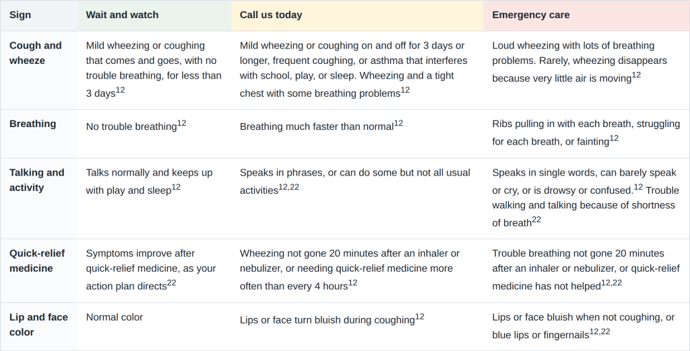
If your child’s symptoms fall in the emergency column, call 911 or go to the nearest ER, and give their quick-relief medicine as directed in their action plan while you get help.23 Severe signs include struggling to breathe, being unable to speak, bluish lips or face, or ribs pulling in with each breath.11
If symptoms fall in the middle column, call us. You can reach our Wake Forest office at 919.556.4779 or our Knightdale office at 919.266.5059. For milder symptoms that keep coming back, such as a cough lasting 3 days or more or asthma that interferes with school, play, or sleep, book an appointment so we can take a look.11
Partnering With Wake Forest Pediatrics
Managing asthma works best as a partnership. Our pediatric asthma care starts with an Asthma Check every 6 months, or more often if your child needs it. It’s the asthma checkup for kids that keeps everyone on the same page. We ask about symptoms and how well treatment is working, include a pulmonary function test for children age 5 and older as determined by the provider, and update your child’s Asthma Action Plan, with copies for home and school.
Our office is recognized nationally as an NCQA Level 3 Patient-Centered Medical Home, and our providers follow the NIH guidelines for asthma management. Before your visit, you can complete the Asthma Control Test (ACT) questionnaire and My Asthma Diary, both available on our asthma care page.
Ready to get started? Book an appointment at our Wake Forest or Knightdale office, and let’s build a plan that keeps your child breathing easy and active.
| Sign | Wait and watch | Call us today | Emergency care |
|---|---|---|---|
| Cough and wheeze | Mild wheezing or coughing that comes and goes, with no trouble breathing, for less than 3 days11 | Mild wheezing or coughing on and off for 3 days or longer, frequent coughing, or asthma that interferes with school, play, or sleep. Wheezing and a tight chest with some breathing problems11 | Loud wheezing with lots of breathing problems. Rarely, wheezing disappears because very little air is moving11 |
| Breathing | No trouble breathing11 | Breathing much faster than normal11 | Ribs pulling in with each breath, struggling for each breath, or fainting11 |
| Talking and activity | Talks normally and keeps up with play and sleep11 | Speaks in phrases, or can do some but not all usual activities11,23 | Speaks in single words, can barely speak or cry, or is drowsy or confused.11 Trouble walking and talking because of shortness of breath23 |
| Quick-relief medicine | Symptoms improve after quick-relief medicine, as your action plan directs23 | Wheezing not gone 20 minutes after an inhaler or nebulizer, or needing quick-relief medicine more often than every 4 hours11 | Trouble breathing not gone 20 minutes after an inhaler or nebulizer, or quick-relief medicine has not helped11,23 |
| Lip and face color | Normal color | Lips or face turn bluish during coughing11 | Lips or face bluish when not coughing, or blue lips or fingernails11,23 |
Sources
- HealthyChildren.org (AAP), What Is Asthma?: https://www.healthychildren.org/English/health-issues/conditions/allergies-asthma/Pages/What-is-Asthma.aspx
- HealthyChildren.org (AAP), Asthma & Exercise: https://www.healthychildren.org/English/health-issues/conditions/allergies-asthma/Pages/Exercise-and-Asthma.aspx
- CDC, FastStats: Asthma: https://www.cdc.gov/nchs/fastats/asthma.htm
- Nationwide Children’s Hospital, What Is Asthma?: https://www.nationwidechildrens.org/family-resources-education/health-wellness-and-safety-resources/resources-for-parents-and-kids/asthma-program-resources/what-is-asthma
- American Lung Association, For Parents of Children with Asthma: https://www.lung.org/lung-health-diseases/lung-disease-lookup/asthma/managing-asthma/children-and-asthma
- NHLBI, Asthma in Kids: https://www.nhlbi.nih.gov/LMBBasthma/asthma-kids
- MedlinePlus, Asthma in children (encyclopedia article): https://medlineplus.gov/ency/article/000990.htm
- AAAAI, Childhood Asthma: https://www.aaaai.org/tools-for-the-public/conditions-library/asthma/childhood-asthma
- ACAAI, Asthma Symptoms: https://acaai.org/asthma/symptoms/
- CDC, About Asthma: https://www.cdc.gov/asthma/about/index.html
- HealthyChildren.org (AAP), Asthma Attack symptom checker: https://www.healthychildren.org/English/tips-tools/symptom-checker/Pages/symptomviewer.aspx?symptom=Asthma+Attack
- HealthyChildren.org (AAP), 9 Asthma Triggers and What to Do About Them: https://www.healthychildren.org/English/health-issues/conditions/allergies-asthma/Pages/asthma-triggers-and-what-to-do-about-them.aspx
- CDC, Controlling Asthma: https://www.cdc.gov/asthma/control/index.html
- NHLBI, Asthma Causes and Triggers: https://www.nhlbi.nih.gov/health/asthma/causes
- MedlinePlus, Asthma in Children: https://medlineplus.gov/asthmainchildren.html
- HealthyChildren.org (AAP), Diagnosing Asthma in Children: https://www.healthychildren.org/English/health-issues/conditions/allergies-asthma/Pages/Diagnosing-Asthma.aspx
- MedlinePlus, Lung Function Tests: https://medlineplus.gov/lab-tests/lung-function-tests/
- NHLBI, Asthma in Children: https://www.nhlbi.nih.gov/health/asthma/children
- CDC, Living with Asthma: https://www.cdc.gov/asthma/living-with/index.html
- HealthyChildren.org (AAP), What Is an Asthma Action Plan?: https://www.healthychildren.org/English/health-issues/conditions/allergies-asthma/Pages/What-is-an-Asthma-Action-Plan.aspx
- HealthyChildren.org (AAP), Asthma Medicines: Quick Relief: https://www.healthychildren.org/English/health-issues/conditions/allergies-asthma/pages/Asthma-Medicines-Quick-Relief.aspx
- CDC, Flu Vaccination among Children with Current Asthma: https://www.cdc.gov/asthma/asthma_stats/flu_vaccination_child.html
- NHLBI, Asthma Action Plan: https://www.nhlbi.nih.gov/sites/default/files/publications/Asthma-Action-Plan-2020_rev_508.pdf

